Why the Toothbrush Never Got a Redesign (And Why That's Finally Changing)
Every morning, you wake up and do the same thing. You walk into the bathroom, reach for your toothbrush, and spend two minutes cleaning your teeth. Then you put it back — usually behind the faucet, tucked into a cup, or shoved in a drawer where no one has to look at it. You don't think about it. Nobody does. And that's exactly the problem.
The toothbrush is one of the most used tools in human history. The average person brushes their teeth over 40,000 times in their lifetime. That's 40,000 interactions with an object that has received almost zero design attention in over a century. Compare that to the coffee mug on your counter, the soap dispenser by your sink, or the candle sitting on your vanity shelf. Those objects were designed with intention. They were made to be seen, to complement a space, to feel good in your hand. The toothbrush? It was designed to be hidden.
But why? And more importantly — why is that finally changing?
The History of a Tool Nobody Questioned
The modern toothbrush as we know it has been around since the late 1930s, when nylon bristles replaced animal hair. Since then, the core design has barely changed. You have a handle. You have a head. You have bristles. That's it. Brands have played with colors, added rubber grips, angled the neck slightly, introduced electric motors — but the fundamental form? Identical.
Walk into any pharmacy today and look at the toothbrush aisle. You'll see dozens of options, all claiming to be better, softer, smarter, or more effective. But look past the packaging and the color variations, and you'll notice something: they all look exactly the same. Same elongated oval head. Same flat bristle layout. Same generic handle. Different brand, same design, every single time.
This isn't because the toothbrush is a perfect object. It's because nobody thought to question it. It became invisible — a utility item that exists in the background of your morning routine, something you buy on autopilot and replace every three months without giving it a second thought.
The Bathroom Has Changed. The Toothbrush Hasn't.
Here's what's interesting: the rest of the bathroom has undergone a massive transformation over the last decade. The modern bathroom is no longer just a functional space. It's a sanctuary. A place of ritual, self-care, and intentional design. People invest in stone soap dishes, refillable glass dispensers, linen hand towels, and artisan candles. They curate what sits on their counter the same way they curate what hangs on their walls.
Skincare has become an art form. The moisturizer has a beautiful bottle. The serum comes in a minimalist dropper. The face wash looks like it belongs in a gallery. These products are displayed proudly on bathroom shelves and countertops because they were designed to be seen.
And then there's the toothbrush. Hidden in a cup. Shoved behind the tap. Out of sight as quickly as possible.
The disconnect is obvious once you see it. The wellness movement redefined every corner of the bathroom — except the dental corner. Nobody challenged the toothbrush because it had always been an afterthought. It was functional, it was cheap, and it was replaceable. That was enough. Until now.
What Polished Changed
Richard West noticed this gap standing in a drugstore, staring at a wall of toothbrushes that all looked exactly the same. Different colors, same shape. Different brands, same design. He wasn't looking for a better bristle or a smarter grip. He was asking a different question entirely: what if the toothbrush was actually beautiful?
That question led to Polished — a toothbrush designed from the ground up with aesthetics as a core feature, not an afterthought.
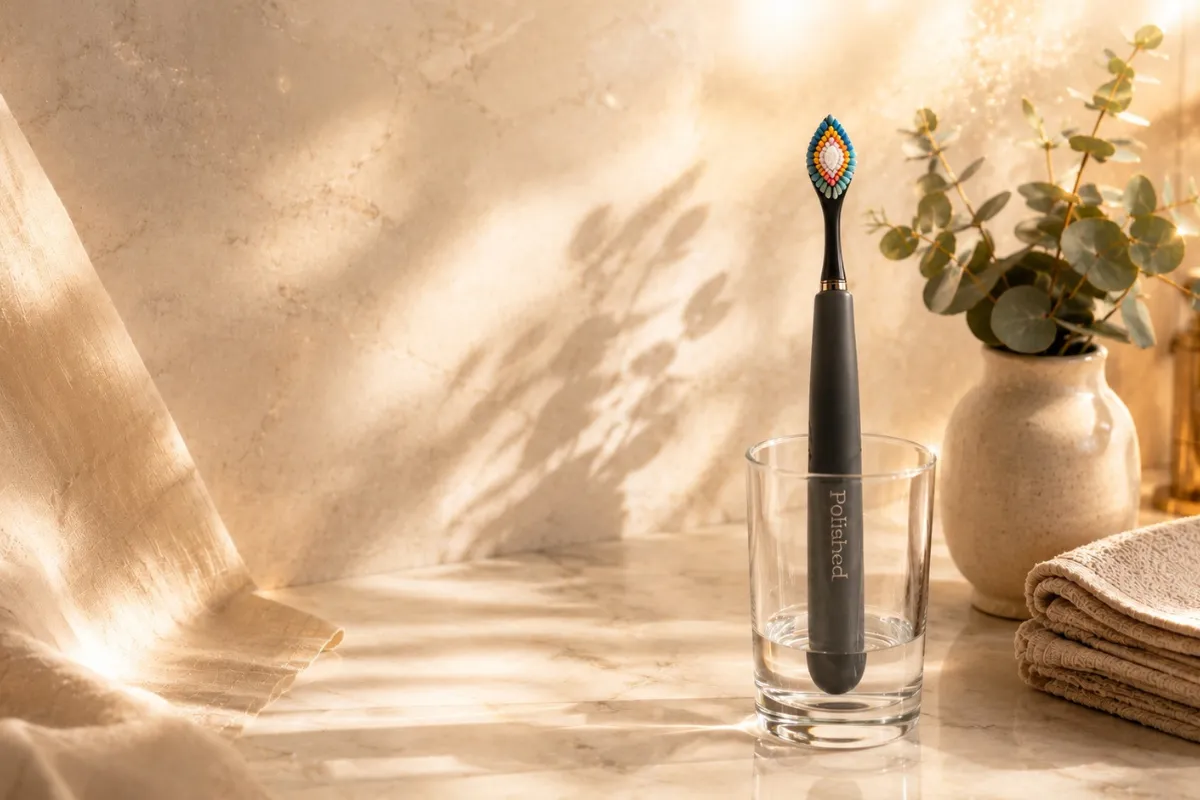
The result is unlike anything currently on the shelf. A diamond-shaped brush head that immediately sets it apart. A patented circular polisher disc (US-2026076473-A1) at the center, surrounded by soft bristles at the perimeter — combining polishing and cleaning in a single, elegant motion. A slim ergonomic handle that feels intentional in your hand rather than cheap and disposable.
Seven colors — Cyan, Green, Orange, Pink, Purple, Teal, Yellow — each designed to complement a bathroom palette rather than clash with it. This isn't about making a toothbrush that comes in fun colors. It's about making a toothbrush that belongs on the counter the same way a candle does.
The Patented Polisher Disc
One of the most significant innovations in Polished isn't just visual — it's functional. The circular polisher disc at the center of the brush head was born from a simple but overlooked question: what if the toothbrush was also a polisher?
For decades, dental polishing has been something that happened twice a year at the dentist's office — a professional step, separate from your daily routine. Polished brings that experience home. The soft polisher disc works gently against the surface of your teeth with every brush, adding a layer of surface care that traditional bristle-only designs simply can't offer.
This isn't a gimmick or a cosmetic feature. It's a patented design innovation that rethinks the mechanics of brushing from the inside out. The bristles clean. The polisher refines. And the diamond-shaped head ensures that every angle of your teeth is reached with equal precision.
Why Now?
The timing isn't accidental. Consumer expectations have shifted dramatically. People are no longer satisfied with purely functional products in their personal care routine. They want tools that reflect their taste, their lifestyle, and their values. They want objects that feel considered — not mass-produced and forgettable.
The success of premium razors, refillable deodorant containers, and designer diffusers proves that people will invest in everyday objects when those objects are worth investing in. The toothbrush has been the last holdout — the one personal care item that somehow escaped the design revolution happening all around it.
Polished is the answer to that gap. It's not trying to be the most technologically advanced toothbrush on the market. It's trying to be the most thoughtfully designed one. And in a category that has looked the same for nearly a century, that's a more radical move than it might sound.
The Object That Earns Its Place
There's a simple test for any object that sits on your bathroom counter: does it earn its place there? Does it look like it belongs, or does it look like something you're tolerating? The moisturizer earns its place. The candle earns its place. The hand soap earns its place.
The toothbrush has never had to earn anything — because it was never designed to be seen.
Polished changes that. It's the first toothbrush designed with the full awareness that it will be looked at, held, and displayed every single day. It's designed for the counter, not the drawer. For the shelf, not the cabinet. For the bathroom you've spent time and care putting together.
The redesign of the toothbrush is long overdue. But the wait is almost over.
Join the waitlist at www.usepolished.com/home-page and be first to hold one.