The Wellness Shelf and What Actually Belongs on It
There is a shelf in your bathroom — or maybe a counter, a ledge, a windowsill — where the objects you actually care about live. The glass serum bottle. The candle that smells like cedar and something you can't quite name. The ceramic soap dish you found at a market and carried home carefully. These things were chosen. They were placed with intention. They belong there.
And then there's your toothbrush.
It doesn't live on the shelf. It lives beside the tap, or in a plastic cup, or in the cabinet where guests don't have to see it. Not because it doesn't get used — you use it more than almost anything else in your bathroom — but because it was never designed to be seen. It was designed to be endured.
That's what the wellness shelf has always been missing. Not more products. Not another serum or a new diffuser. It's been missing a toothbrush that actually belongs there.
What the Wellness Movement Got Right
Over the last decade, the way people think about personal care has fundamentally shifted. Wellness is no longer just about what you consume or how you exercise. It's about the quality of your daily rituals — the small, repeated moments that make up your morning and evening routine.
People started asking better questions about the objects surrounding those rituals. Is this soap refillable? Is this packaging sustainable? Does this bottle look beautiful on my counter? The answers drove an entirely new category of products — premium, considered, designed for visibility.
The skincare industry responded first. Brands like Aesop, Glossier, and Tatcha built entire identities around beautiful packaging and intentional design. The product inside mattered, but so did the object itself — how it felt in your hand, how it looked on your shelf, what it communicated about you and your space.
The candle industry was already there. A candle is functionally simple — wax, wick, fragrance. But the premium candle market is enormous because people understand intuitively that the object matters. The vessel it comes in, the weight of it, the way it sits on a surface — these things are part of the experience.
Bathroom hardware followed. Stone soap dishes replaced plastic ones. Brushed brass replaced chrome. Linen replaced polyester. Every corner of the bathroom was reconsidered, reimagined, and elevated.
Every corner except one.
The Dental Corner: The Last Frontier
The dental aisle never got the memo. Walk into any pharmacy and you'll find the same wall of toothbrushes it's always been — a chaos of primary colors, loud packaging, and identical silhouettes competing for your attention. The branding is aggressive. The design is invisible. The assumption is that you'll grab whatever is cheapest or most familiar and leave.
And most people do. Because nobody ever gave them a reason to do anything else.
This isn't a criticism of the people who make toothbrushes. It's an observation about a category that has never been challenged. Dental care has always been positioned as obligation, not ritual. You brush because you have to, not because the experience is worth savoring. The tool reflects that — disposable, generic, designed for function and nothing else.
But here's the thing: function and beauty are not opposites. The best-designed objects in the world are both. A well-made knife is a pleasure to hold and also cuts perfectly. A beautiful notebook makes you want to write in it. A gorgeous coffee cup makes the morning ritual feel worth waking up for.
Why should the toothbrush be any different?
What Belongs on the Wellness Shelf
The objects that earn a place on the wellness shelf share a few qualities. They are intentionally made. They are visually considered. They feel like the person who bought them made a choice, not a compromise. And they contribute to the mood and aesthetic of the space they inhabit, rather than detracting from it.
The moisturizer earns its place. The face oil earns its place. The beautiful towel folded on the rail earns its place.
Polished was designed to earn its place.
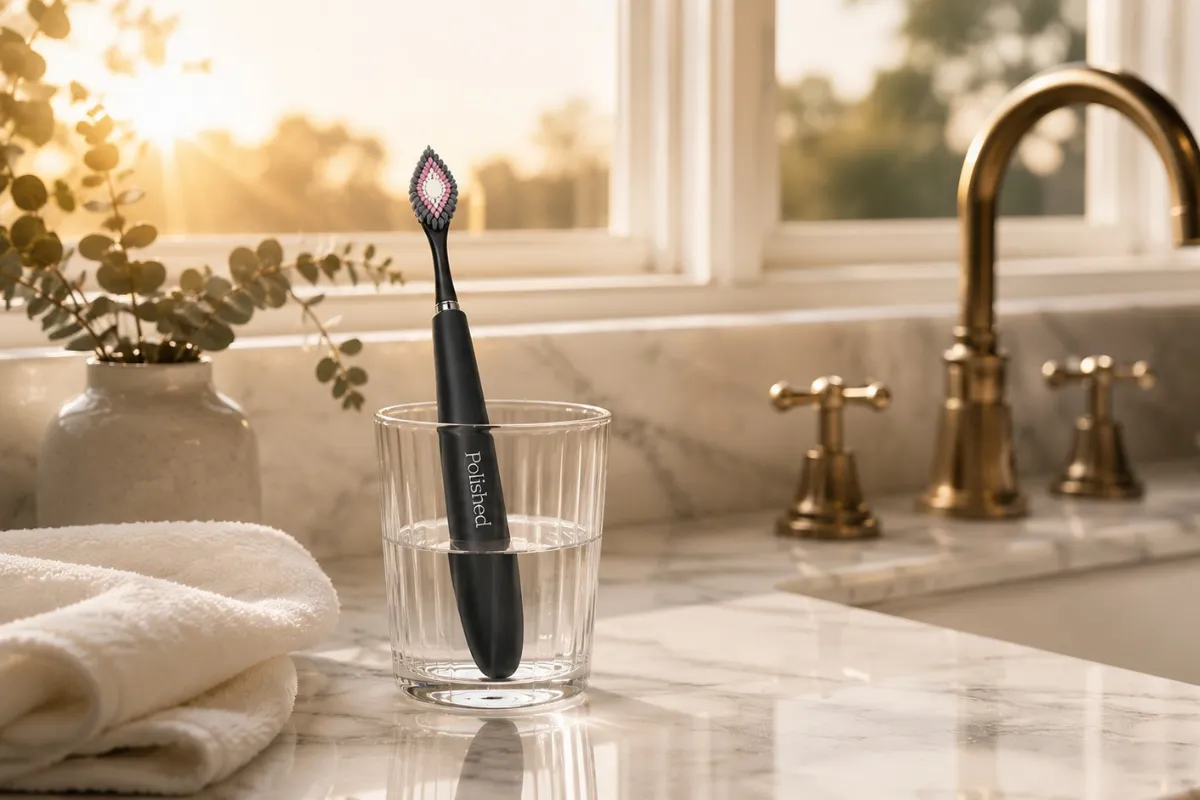
The diamond-shaped brush head isn't just a visual statement — it signals that someone thought carefully about this object. The patented circular polisher disc at the center (US-2026076473-A1) isn't decoration — it's a genuine functional innovation that brings a professional polishing step into your daily routine. The slim ergonomic handle isn't a gimmick — it feels different in your hand because it was designed to.
And the seven colors — Cyan, Green, Orange, Pink, Purple, Teal, Yellow — weren't chosen arbitrarily. They were chosen to complement the palettes that already exist in thoughtfully designed bathrooms. Not to shout. Not to clash. To belong.
The Ritual Argument
There's a reason the wellness movement talks so much about ritual. Rituals are repeated actions that carry meaning beyond their function. Making coffee in the morning isn't just about caffeine — it's a moment of quiet before the day begins. A skincare routine isn't just about moisturizing — it's a few minutes of attention and care directed at yourself.
Brushing your teeth is already a ritual in the strictest sense — you do it every single day, twice a day, for your entire life. 40,000 times, on average. It's one of the most consistent habits a human being can have.
But it has never been treated as a ritual worth honoring. The tool has always been generic. The experience has always been purely functional. You brush, you rinse, you move on. The two minutes don't feel like anything.
Polished changes that. When the tool in your hand is beautiful, the action changes. Not dramatically — but meaningfully. The same way a good pen makes writing feel different, or a heavy mug makes coffee feel different. The object shapes the experience of using it.
Brushing with Polished is still brushing. But it's brushing with something worth holding.
Curating with Intention
The wellness shelf is, at its core, an act of curation. You are choosing what surrounds you during the most private, personal moments of your day. You are deciding what belongs and what doesn't. You are building a small environment that reflects how you want to feel when you're in it.
Every object on that shelf was a decision. And for too long, the toothbrush has been the one decision you didn't really get to make — because nothing worth choosing existed.
Now it does.
Polished belongs on the wellness shelf — not as a novelty, not as a conversation piece, but as a genuinely considered object that has finally caught up with everything around it. It was designed for the counter you've spent time putting together. For the bathroom that already has the candle, the serum, the soap dish, and the towel. For the ritual that deserved a better tool all along.
Join the waitlist at www.usepolished.com/home-page and be first to hold one.