40,000 Brushings — Why the Tool You Use Every Day Deserves to Be Beautiful
Think about the objects you use every single day. Your coffee mug. Your phone. Your keys. The pillow you sleep on. At some point, someone made a decision about each of those things — a design decision, a material decision, a color decision. Someone decided what they would look like, how they would feel, and what experience they would create for the person using them.
Now think about your toothbrush.
You will brush your teeth approximately 40,000 times in your lifetime. Twice a day, two minutes each time, for decades. It is one of the most consistent, most repeated physical interactions you will have with any object in your entire life. And yet — the toothbrush is almost universally treated as a throwaway. A commodity. Something you buy without thinking and replace without noticing.
That number — 40,000 — is worth sitting with. Because it reframes the question entirely. The question isn't why would anyone spend more thought on a toothbrush? The question is: why hasn't anyone sooner?
Frequency Changes Everything
When you use something rarely, design is a bonus. A nice-to-have. But when you use something every single day — twice a day, for your entire adult life — design becomes something else entirely. It becomes part of your experience. Part of your routine. Part of the texture of your daily life.
Consider the coffee mug. The average coffee drinker uses their mug every single morning. That frequency is exactly why people care about their mugs. They have favorites. They feel a small but real difference when they use a mug they love versus one they grabbed out of obligation. The frequency of use amplifies the quality of the experience. A beautiful mug is worth having because you'll hold it every day. An ugly one drags the ritual down, subtly, every morning.
The same logic applies — even more forcefully — to the toothbrush. More frequency, more impact. If your mug deserves to be beautiful, your toothbrush deserves it ten times more.
But the market hasn't reflected this logic. The toothbrush aisle has stayed the same for nearly a century because the assumption has always been that frequency and disposability go together. That if something gets used constantly, it must be cheap. That if something gets replaced regularly, it doesn't need to be considered.
Polished rejects that assumption entirely.
The Design Gap Nobody Talked About
There's a concept in design called the "invisible product" — an object so embedded in daily life that people stop seeing it. They use it automatically, without thought or attention. And because they don't see it, they don't question it. They don't ask whether it could be better, more beautiful, or more worthy of the moment it inhabits.
The toothbrush is the ultimate invisible product. You reach for it half-asleep. You put it down still half-asleep. It exists at the edges of consciousness — functional, familiar, forgotten.
But invisible doesn't mean unimportant. In fact, the invisibility of the toothbrush is precisely what makes the design gap so significant. An object used 40,000 times that nobody has bothered to make beautiful is an object that has been failing its users for a century. Not functionally — toothbrushes clean teeth perfectly adequately. But experientially. Aesthetically. In terms of what it contributes to the space it occupies and the ritual it anchors.
That gap is what Polished was created to close.
What Richard West Saw
Richard West didn't set out to disrupt the dental industry. He was standing in a drugstore, looking at a wall of toothbrushes that all looked exactly the same, and he had a simple reaction: this doesn't make sense.
Here was a product used by every person on earth, twice a day, for their entire lives — and it looked like it had been designed once, fifty years ago, and never revisited. The colors changed. The branding changed. The packaging got louder. But the object itself? Identical.
He started sketching. Then prototyping. Then asking a question that nobody in the dental industry had thought to ask in half a century: what if the toothbrush was also a polisher?
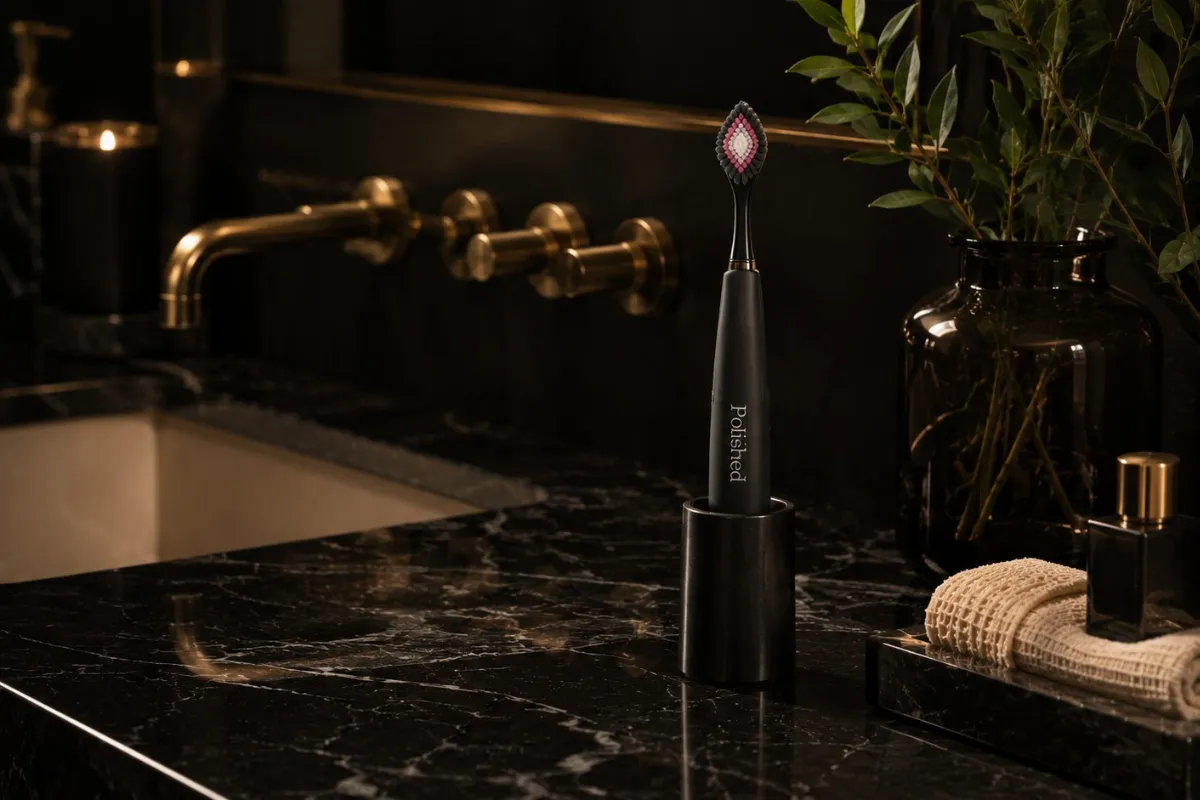
That question led to the patented circular polisher disc at the center of the Polished brush head (US-2026076473-A1). A soft white disc, surrounded by gentle bristles at the perimeter, set into a diamond-shaped head that looks unlike anything currently on the market. The polisher adds a surface refinement step to every brushing — bringing a professional-grade element into a daily home routine. The diamond shape ensures complete coverage and makes the brush instantly recognizable as something different.
The handle is slim and ergonomic — not rubber-gripped and chunky, but clean and intentional, like something that belongs in a well-designed space rather than hidden from one.
Seven colors were developed — Cyan, Green, Orange, Pink, Purple, Teal, Yellow — each chosen to complement rather than compete with the bathroom environments people have spent real time and care creating.
The result is a toothbrush that looks like it was designed in 2026 rather than 1970. Because it was.
The Object You Hold Shapes the Experience
There's substantial research on how the physical properties of objects affect our perception of the experiences associated with them. Heavier cutlery makes food taste better. A well-designed chair makes a conversation feel more significant. The weight of a book in your hands changes how seriously you take what's inside it.
This isn't magic or marketing. It's the straightforward reality that human beings don't experience objects in isolation from their appearance and feel. The physical experience of using something is inseparable from the sensory experience of holding it, looking at it, and placing it back down.
Your toothbrush is no exception. The tool you hold shapes the ritual. A heavy, beautiful, intentionally designed brush in your hand changes the two minutes you spend using it — not dramatically, but meaningfully. The same way a good knife changes the experience of cooking, or a beautiful notebook changes the experience of writing.
You don't have to consciously notice it for it to be true. You just have to brush with Polished once and feel the difference.
40,000 Reasons to Choose Better
Forty thousand. That's the number.
Forty thousand mornings. Forty thousand evenings. Forty thousand moments standing at your bathroom counter, reaching for the same object, performing the same ritual. Over a lifetime, that adds up to roughly 1,333 hours — more than 55 full days — spent with a toothbrush in your hand.
The question isn't whether you can afford to care about what that object looks like. The question is whether you can afford not to. Because that time is going to pass regardless. Those 40,000 brushings are going to happen whether your toothbrush is beautiful or generic. Whether it belongs on your counter or gets hidden in a drawer. Whether it was designed with intention or manufactured without thought.
Polished exists because 40,000 times is too many times to settle for something ordinary.
It was designed for the counter you've curated. For the bathroom ritual you've built. For the two minutes twice a day that, added together, constitute one of the longest and most consistent relationships you'll ever have with any object in your life.
The tool deserves to be beautiful. And now, finally, it is.
Join the waitlist at www.usepolished.com/home-page and be first to hold one.